
Thread percentage explained: why 75%
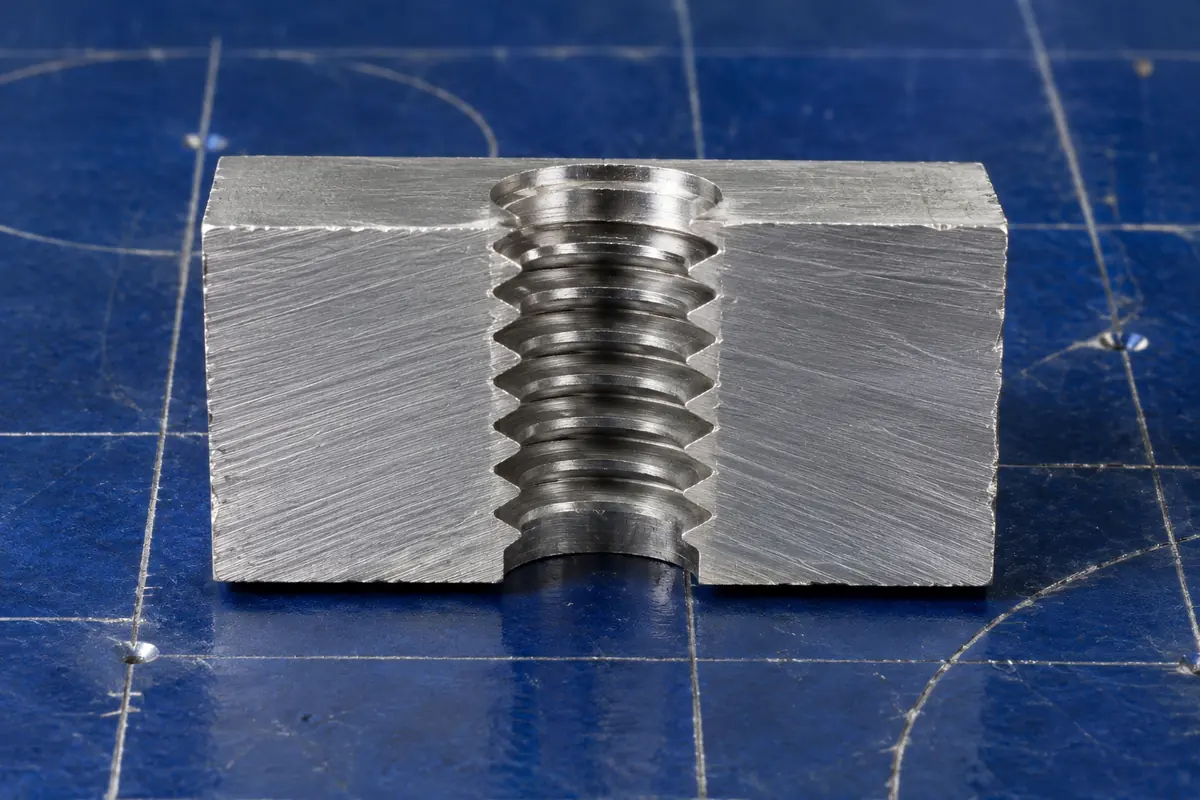
Every tap drill on a chart is chosen for a percentage of thread, usually 75%. The number sounds like a compromise, and it is one, but it is a very good one. Above 75% you pay a lot in tapping effort for very little extra holding power.
What the percentage means
A tap cuts a thread into the wall of the drilled hole. The smaller the hole, the deeper the thread. "Percent of thread" compares the depth a given hole allows with a full-depth reference thread. It is set by the drill, using the formula in the tap drill formula guide: for inch threads, % = threads per inch × (major diameter − drill) ÷ 0.01299.[1]
Because the reference depth is deeper than the modern standard thread profile, a hole drilled to the basic minor diameter scores about 83% on this scale, not 100%. A "75%" thread is closer to full engagement than it sounds.
Why 75%
The case for stopping at about 75% is that strength stops climbing and torque does not. Tapmatic, a maker of tapping attachments, puts it this way: beyond about 75% of full thread the strength of the hole does not increase, yet the torque needed to tap it rises exponentially.[2] It adds that size becomes harder to hold and taps break more often.[2]
The figure most often quoted comes from Bob Warfield in Cutting Tool Engineering: a 100% thread is only 5% stronger than a 75% thread but needs three times the torque.[3] CNCCookbook attributes the same numbers to Kennametal.[4] Neither source publishes the test behind them, so read them as an industry rule of thumb rather than a measurement. David Miskinis of Greenfield Industries made the same point in more general terms: high-percentage threads do not significantly increase the strength of the joint.[5]
So 75% became the norm. Browne & Co., a tooling distributor, calls 75% the norm for 60-degree threads, with a usable range of 50 to 85% and a recommended range of 65 to 75%.[6]
Percentages by material and depth
Tap makers publish tables that adjust the target for the material and the job. OSG's version:[1]
| Job | Free-cutting metals | Hard or tough metals |
|---|---|---|
| Deep hole | 60 to 70% | 55 to 65% |
| Average commercial work | 65 to 70% | 60 to 70% |
| Thin sheet, stampings | 75 to 85% | not given |
OSG's free-cutting group includes aluminum, brass, bronze, cast iron, copper, mild steel and tool steel; the hard or tough group includes cast steel, drop forgings, Monel, nickel steel and stainless. A "deep hole" is generally one deeper than 1-1/2 times the hole diameter.[1] Tapmatic's table matches except for free-cutting commercial work, where it allows 65 to 75%.[2]
OSG's general advice goes further than the usual 75%: a minor diameter that gives 55 to 65% thread is sufficient for most requirements, and the rule is to use the largest drill that leaves adequate strength.[1]
When to go lower
Tough materials. Tapmatic's rule is that the tougher the material, the less thread you need, and that stainless steel, Monel and some heat-treated alloys can be tapped to as little as 50% without losing usefulness.[2] Machine shop charts reflect this. The University of Wisconsin physics instrument shop's chart uses 50% thread for stainless, steels and iron and 75% for aluminum, brass and plastics.[7]
Deep holes. Warfield advises dialing back below 75% for deep holes and for hard, tough materials.[3] The longer the tap is in the cut, the more friction and chip load it carries.
Higher-strength steels. Browne & Co. notes that larger holes, meaning less thread, can work better in higher-tensile steels to cut tapping torque.[6]
There is a floor. GWS Tool Group, a tap maker, recommends no less than 65% thread when the engagement is shorter than three diameters.[8]
When to go higher
Thin material is the exception. With only a few threads engaged, each one carries more of the load. Miskinis recommends the smallest drill, and so the highest percentage, for thin parts,[5] and OSG's thin-sheet column runs from 75 to 85%.[1] He also notes that in very thin nuts, one or two threads may not be strong enough to carry the load at all.[5]
The class-limit catch
Dropping the percentage has a limit that charts rarely mention. A thread made to a class, such as 2B for inch or 6H for metric, has a maximum minor diameter. Drill above it and the thread may fail a go/no-go gauge even if it holds fine.
For 1/4-20 class 2B, OSG gives a minor diameter between 0.1960 and 0.2070 in.[1] Work the lowest percentage that allows: 20 × (0.250 − 0.207) ÷ 0.01299 = 66%. A 60% hole for stainless would be 0.2110 in, outside the class. This is what OSG means when it says a higher percentage is sometimes needed to meet the minor-diameter limits.[1]
Metric works the same way. Brighton-Best's 6H table gives M6 x 1 a minor diameter of 4.917 to 5.153 mm,[9] which works out to roughly 65 to 83% thread. If the part has to pass a gauge, stay inside the window; if it only has to hold a screw, the lighter thread is fine.
Engagement length matters more
How many threads are engaged usually matters more than how deep each one is. Fastenal's engineering guidance suggests an engagement of about one diameter in carbon steel and about 1-1/2 diameters in aluminum.[10] Nord-Lock gives one diameter in steel and two in aluminum, and says softer materials and special alloys need more.[11] Fastenal also notes that load is not shared evenly: in a 7/8-9 Grade 8 nut, the first engaged thread carries 34% of the load.[10] If a thread is marginal, make it longer before you make it deeper.
One thread at five percentages
Here is what the choice looks like for a single thread, 1/4-20, worked with the inch formula. The exact hole for each target falls between stock drills, so the nearest drills and the thread each actually gives are listed.
| Target | Exact hole | Nearest drills (thread %) |
|---|---|---|
| 60% | 0.2110 in | #4, 0.2090 in (63%); #3, 0.2130 in (57%) |
| 65% | 0.2078 in | #5, 0.2055 in (68.5%); #4 (63%) |
| 70% | 0.2045 in | #6, 0.2040 in (71%) |
| 75% | 0.2013 in | #7, 0.2010 in (75%); 13/64 in (72%) |
| 80% | 0.1980 in | #8, 0.1990 in (78.5%) |
The whole useful range spans five number sizes, about 0.010 in. That is why a drill one size off rarely ruins a thread, and why the class limits, which cover 0.011 in for this thread, are the real constraint.
Measuring what you actually got
The percentage on a chart describes the drill. The hole is usually bigger: Miskinis measured #7 drills cutting about 0.0038 in oversize, turning a 75% drill into roughly a 70% hole.[5] If the result matters, measure the hole with a pin gauge or small-hole gauge and put that number into the formula instead of the drill size. A worn or badly sharpened drill can cut further oversize still.
Common mistakes
- Drilling smaller "for strength." Above about 75% the thread barely gets stronger while tapping torque climbs steeply, which is exactly when taps snap.[2][3]
- Using a 50% drill on a part that must pass a gauge. It may hold perfectly and still be rejected, because the hole is outside the class minor diameter.[1]
- Fixing a weak thread with depth instead of length. More engaged threads usually help more than deeper ones.[10]
- Using one percentage for everything. Thin sheet needs more thread, tough alloys and deep holes need less.[1][5]
Worked examples
Stainless, 1/4-20, must pass a 2B gauge
Target 60%: 0.250 − 0.01299 × 60 ÷ 20 = 0.2110 in. Too large for 2B (max minor 0.2070)
Largest legal hole: 0.2070 in, which is 66%
A #5 drill (0.2055 in) gives 20 × (0.250 − 0.2055) ÷ 0.01299 = 68.5%. Use it.
Thin sheet, 10-24, at 80%
0.190 − 0.01299 × 80 ÷ 24 = 0.1467 in
#26 drill (0.1470 in): 79.4%. #25 (0.1495 in): 74.8%
Both are inside the 2B minor diameter for 10-24. Choose #26 for the thin part.
The calculator lets you set any percentage and shows the nearest drills with the thread each one leaves.
Sources
- Tapping Guide Vol. 3, OSG
- Tapping Torque vs Thread Strength, Tapmatic
- Seven Ways to Avoid Breaking Taps, Bob Warfield, Cutting Tool Engineering (2022)
- Tap Drill Chart, CNCCookbook Attributes the 5% / 3x figures to Kennametal.
- Know What You're Tapping, David Miskinis, Cutting Tool Engineering (1997)
- Tap Drill Hole Size: Why it Matters, Browne & Co.
- Drill chart, UW-Madison Physics instrument shop
- Tapping Tip: Don't Let Percent of Thread Derail Your Part, GWS Tool Group
- Thread Details, Metric Series, Brighton-Best International
- Screw Thread Design, Fastenal Engineering
- Thread engagement in a tapped hole, Nord-Lock
Found an error? Email [email protected]. Our editorial policy explains how guides are researched and corrected.
 Thread plug gauge
 Number drill set