
Blind holes: how deep to drill before tapping
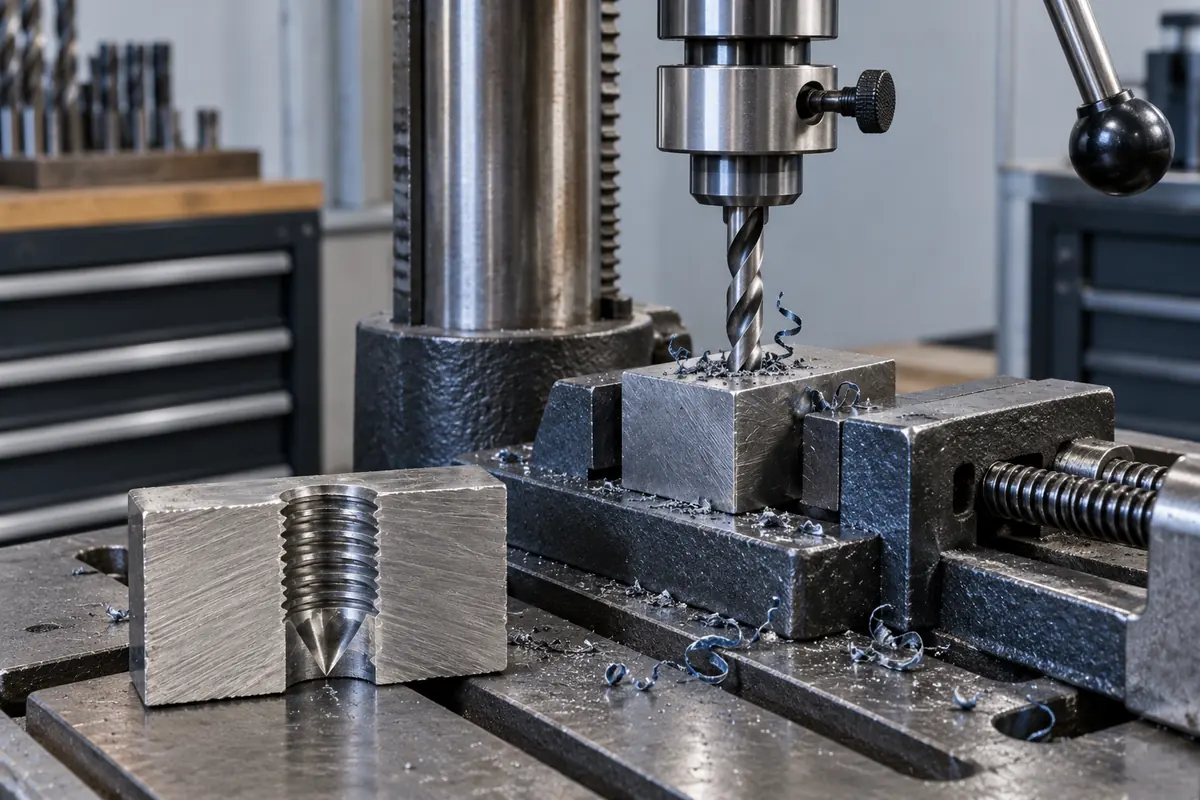
A through hole forgives a lot. A blind hole does not: the tap has a tapered lead that cannot cut full threads, the drill leaves a cone at the bottom, and chips need somewhere to go. Drill too shallow and you either get short threads or a broken tap. The depth is easy to work out once you know the four parts that add up to it.
The four parts of the depth
Measured from the top surface, a blind hole needs to be at least:
full-thread depth + tap chamfer length + one pitch + drill point length
Cutting Tool Supply, an Illinois tooling distributor, gives the first three: drill at least one thread, or one pitch, beyond the chamfer of the tap.[1] The fourth comes in because drills are usually measured to the full diameter, and the cone at the tip adds length below that.[2]
1. How much full thread
This is a design choice. The usual guidance is to engage about one diameter of thread in steel and more in softer metals. Nord-Lock gives about one times the nominal diameter in steel and two times in aluminum, and says softer materials and special alloys need more.[3] Tameson's engagement chart gives ranges: 1.0 to 1.5 diameters for steel, 1.5 to 2.0 for cast iron and brass, and 2.0 to 2.5 for aluminum.[4] None of these sources cites a standard, so treat them as a starting point and use the fastener maker's data for anything critical.
Extra thread depth beyond what you need adds little strength, because most of the load sits on the first few threads, and it makes the tap's job harder.
2. The tap's chamfer
Every tap starts with a tapered section that cuts the thread gradually. Those tapered threads never cut a full-depth thread, so the hole must be at least that much deeper than the full thread you want. Chamfer length depends on the tap:
| Taper tap | 7 to 10 threads[5][6] |
|---|---|
| Plug tap | 3 to 5 threads, the most widely used[5][6] |
| Semi-bottoming | 2 to 2-1/2 threads[5] |
| Bottoming | 1 to 2 threads[5][6] |
Kennametal's advice is to use the longest chamfer the hole allows.[7] Cutting Tool Supply adds that a bottoming chamfer creates the most tapping torque and should be used only when the threads must come close to the bottom.[6]
Metric taps made to DIN 2197 use letters for the chamfer form. ISCAR's catalog lists form C, 2 to 3 threads, for blind holes, and forms E (1.5 to 2) and F (1 to 1.5) as very short chamfers to avoid where possible.[8]
The chamfer length in inches is the number of chamfer threads times the pitch. For a plug tap with four chamfer threads in 1/4-20, that is 4 × 0.050 = 0.200 in.
3. One extra pitch
Kennametal explains the extra pitch as clearance at the bottom of the hole for spindle over-spin and chips.[7] When tapping by hand it gives you a little warning before the tap hits bottom. If a machine tends to overshoot, Cutting Tool Supply says to add at least one pitch beyond that over-travel as well.[1]
4. The drill point
A twist drill's tip is a cone. If you set the depth to the full diameter of the hole, the point goes further. Haas Automation gives the allowance: for a 118° point, add 0.3 times the drill diameter; for a 135° point, add 0.207 times.[2] These come straight from the geometry: half the diameter divided by the tangent of half the point angle.
If you measure depth from the drill tip, as a depth stop on a hand drill does, you still need to account for the cone, because the full diameter ends that far above the tip.
The whole formula
Drill depth (to full diameter) = thread depth + (chamfer threads × pitch) + pitch
Drill depth (to the tip) = the above + 0.3 × drill diameter (118° point)
Some shops add more for chip room. Cutting Tool Supply's page suggests about one tap diameter of extra depth for chips with straight-flute hand taps, and an extra half diameter for plug or taper chamfers up to 3/8 in.[1] AIMS Industrial, an Australian tool retailer, recommends drilling at least three thread pitches deeper than the thread depth.[9] Extra depth costs little and saves taps.
Worked examples
Cutting Tool Supply's 1/4-20 example (bottoming tap)
0.375 in thread + 0.100 in chamfer (two threads × 0.050) + 0.050 in one pitch = 0.525 in to full diameter[1]
Add the 118° point of a #7 drill: 0.3 × 0.201 = 0.060 in. Depth to the tip: 0.585 in
1/4-20 with a plug tap, 1.5 diameters of thread
0.375 in + (4 × 0.050) + 0.050 + 0.060 = 0.685 in to the tip
The plug tap needs 0.100 in more than the bottoming tap for the same thread. If the part is not that thick, start with the plug tap and finish with a bottoming tap. The size pages on this site assume this setup.
Haas's metric example (135° drill)
12 mm drill, 25 mm of full diameter needed: 0.207 × 12 = 2.484 mm; 25 + 2.484 = 27.484 mm[2]
M8 x 1.25 with a plug tap, 12 mm of thread
12 + (4 × 1.25) + 1.25 + (0.3 × 6.8) = 12 + 5 + 1.25 + 2.04 = 20.3 mm to the tip
Working backwards
Sometimes the depth is fixed, for example a hole that cannot break through the other side. Kennametal's method turns the formula around: subtract the full thread length plus one pitch from the drill depth, and what is left is the longest chamfer you can use.[7] In its 1/4-20 example, a 0.473 in drill depth with 0.250 in of thread leaves room for 3.5 chamfer threads, and Kennametal suggests a 3-thread chamfer for margin.[7]
Common mistakes
- Forgetting the chamfer. Drilling exactly the thread depth and then tapping with a plug tap leaves the last three to five threads incomplete.[5]
- Forgetting the point. A depth stop set to the full-diameter depth on a 118° drill leaves the hole short by 0.3 times the drill diameter at full size.[2]
- Leaving chips in the bottom. Chips packed under the tap stop it short and are the most common reason taps break in blind holes; clear them before you change taps.
- Not allowing for over-travel. On a machine, add at least one pitch beyond any over-travel.[1]
- Going straight to the bottoming tap. It cannot start a thread on its own and is the hardest tap to turn.[6]
In practice
Chip management. In a blind hole, chips have nowhere to fall. Spiral flute taps lift chips up and out and are made for blind holes; spiral point taps push chips ahead and belong in through holes.[10] Thread-forming taps make no chips at all, though they need a longer lead: Missouri Carbide calls for 3 to 4 pitches beyond the full thread with its bottom chamfer.[11]
Hand tapping depth. A straight-flute hand tap stores chips in its flutes, and USCTI's rule of thumb for a four-flute hand tap is a maximum depth of 1-1/2 times the tap diameter.[10] Deeper than that, back the tap all the way out to clear chips.
Machine tapping. Self-reversing tapping heads keep feeding a little after the spindle stops. One maker's head advances 0.140 in, give or take 0.004 in, so you stop the spindle that much short.[12] Check the figure for your own head.
Each tap drill size page works out the blind-hole depth for that thread with a plug tap, using the method above.
Sources
- Determining the Minimum Tap Drill Depth, Cutting Tool Supply
- Working out Drill Depth, Haas Automation UK
- Thread engagement in a tapped hole, Nord-Lock
- Thread Engagement Chart, Tameson
- Thumbnail Guide to Understanding Chamfers for Thread Cutting Taps, F&L Technical Sales
- Tap Chamfers, Cutting Tool Supply
- Tech Tip: Chamfer length, Kennametal (via MSC)
- Threading Catalog 2023, p. 380, ISCAR
- Broken Tap Removal, AIMS Industrial
- Tap Style Selections by Chip Management, USCTI
- Engineering Data: Thread Forming Taps, Missouri Carbide
- Self Reversing Tapping Heads, Accusize Tools One product's specification.
Found an error? Email [email protected]. Our editorial policy explains how guides are researched and corrected.
 Bottoming tap
 Drill stop collars
 Depth gauge caliper