
How to remove a broken tap
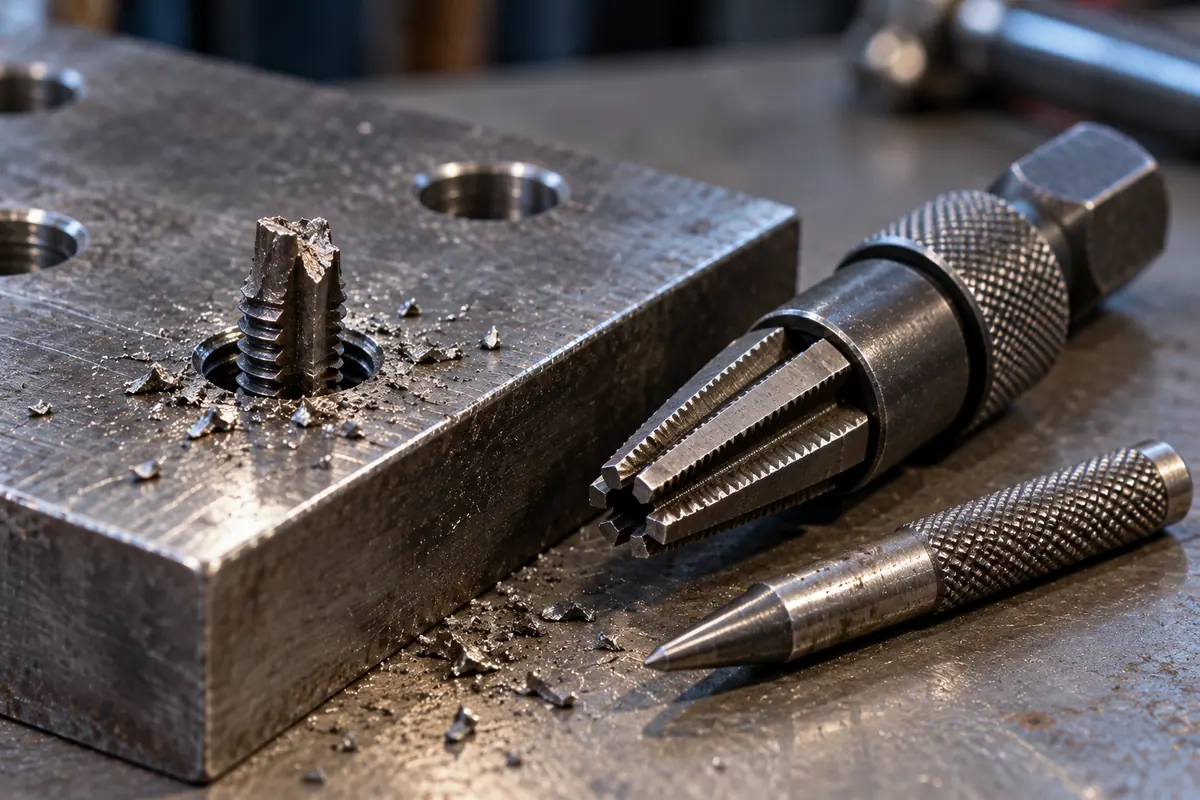
A tap is harder than almost anything you would drill it with, and brittle enough to shatter. That combination makes a broken tap one of the worst problems in a small shop. The good news is that there are several ways out, and the right one depends on how the tap broke, what the part is made of, and what equipment you can get to.
Stop and assess
The first instinct is to grab a drill. Do not. AIMS Industrial, an Australian tool retailer, puts it as a rule: do nothing until you have assessed the situation and chosen a method.[1] An ordinary high-speed steel drill will not cut a hardened HSS tap; it snaps and can push pieces deeper.[1]
Look at three things. How much of the tap is left above the surface? What is the part made of? And is the tap a straight-flute hand tap, or a spiral flute or spiral point tap? Those answers pick the method.
Tap extractors
A tap extractor has steel fingers that slide down into the broken tap's flutes and grip it, so you can turn it out with a tap wrench.[2] McMaster-Carr describes them as made for taps with straight flutes,[2] and they come in two-, three- and four-flute versions by size; parts are not interchangeable between flute styles.[3]
Walton's instructions run like this: clear all the chips, push the fingers into the flutes, bring the holder down to the tap, slide the sleeve down to the work, then turn back and forth a few times to loosen before backing the tap out.[3] An extractor works best when the tap broke off near flush with the surface.[4]
If it will not move, stop. AIMS warns that forcing it will break the extractor's brittle fingers into the hole and make things far worse, and suggests soaking with penetrating oil for 10 to 15 minutes before trying again.[1]
Shattering it out
Because a tap is brittle, a sharp blow with a center punch can break it into pieces that can be picked out. It is cheap. Pennsylvania Tool Sales calls it cost-effective but the least effective method.[5] Pieces fly, so eye protection is not optional.[4] It works best on small taps in through holes, where fragments can be driven out the other side. In a blind hole the pieces stay at the bottom and have to be fished out with a magnet or pick, and some will always be wedged in the thread.
Carbide drills and end mills
Solid carbide is hard enough to cut a tap. McMaster-Carr sells carbide drill-out removers: drill a starter hole in the tap, drill the tap out, then pick out what is left with a scriber.[2] Travers Tool's instructions for Omegadrill tap-removal drills call for a rigid machine setup, 1,200 to 2,500 rpm, and drilling dry or with straight cutting oil, never water-based coolant.[6] Their technical sheet adds: break off the jagged top first, spot it, and avoid any side load, because solid carbide will not tolerate deflection.[7]
AIMS describes a carbide end mill method: use an end mill slightly smaller than the tap's minor diameter, run it about 30% slower than normal, take no more than 0.5 mm per pass, and keep cutting fluid on it the whole time.[1] The leftover thread slivers can then be picked out of the original threads, which often survive.
EDM
Electrical discharge machining erodes the tap with sparks instead of cutting it. There are no cutting forces and the erosion is tightly controlled, which makes it the most reliable and cleanest method.[4] Penn Tool agrees, but notes most small shops do not have the equipment.[5] Portable EDM tap removers exist; one model handles M2 to M30 taps, drills and screws.[8] If you don't have one, ask local machine shops whether they do tap removal; for a valuable part it is worth the call.
Dissolving with alum
A solution of alum dissolves steel without much effect on aluminum, so a steel tap stuck in an aluminum part can be eaten away. MusicMedic, an instrument repair supplier, describes the method: make a saturated solution of alum in boiling water, use an aluminum pot, keep the part simmering for several hours and top up the water as it boils off.[9] AIMS says the method works only on aluminum workpieces and takes 2 to 8 hours for small taps, or overnight.[1] Sources disagree on brass parts: MusicMedic includes them, AIMS says aluminum only.
Read the safety data sheet for the alum you buy and wear goggles.[9]
Welding on a handle
If at least 3 mm of the tap is sticking out, a welder can attach a rod or a nut to it and turn it out. AIMS says to let it cool slightly but not quench it, and to avoid the method on aluminum parts.[1] Penn Tool suggests TIG welding with a 309 or 312 rod.[5]
Repairing the hole
Removal often damages the thread. AIMS's suggestion is to drill and tap oversize and fit a helical thread insert, so the original screw size still fits.[1] Another option is to move up to the next screw size if the design allows it.
Be honest about the part's value, too. A bracket you can remake in twenty minutes is rarely worth an evening of picking carbide-hard fragments out of a hole. Save the slow, careful methods for the parts that took hours to make or cannot be replaced.
Which method to use
| Broken near flush, straight flute, not jammed | Tap extractor, after penetrating oil |
|---|---|
| Small tap, through hole, cheap part | Shatter with a punch, wear eye protection |
| Steel or iron part, milling machine available | Carbide drill or end mill |
| Aluminum part | Alum solution, or EDM |
| Valuable part | EDM, often as a shop service |
| Several millimetres sticking out, steel part | Weld a nut or rod on |
Common mistakes
- Drilling a hardened tap with an HSS drill. The drill loses, and the broken drill joins the broken tap.[1]
- Forcing an extractor. Its fingers are thin and brittle. If the tap will not move after oil and a gentle back-and-forth, change methods.[1]
- Using an extractor on a spiral flute tap. Extractors are made to grip straight flutes.[2]
- Carbide in a hand drill with side load. Solid carbide tolerates no deflection.[7]
- Water-based coolant on a carbide removal drill. Travers says dry or straight cutting oil, never coolant.[6]
- Quenching a welded-on nut. Let it cool slightly instead.[1]
- No eye protection. Every one of these methods can throw hard, sharp fragments.[4]
Preventing the next one
Bob Warfield's list in Cutting Tool Engineering covers most of it: use the right drill size, since there is no single correct drill for a tap; use form taps where you can; use a proper tapping fluid; stop the tap from twisting in its holder; use spiral flute taps in blind holes; and never crash a tap into the bottom of a blind hole.[10] AIMS adds drilling blind holes at least three pitches deeper than the thread.[1]
For hand tapping, the how to tap a hole guide covers starting square and backing off to break chips, and the blind hole guide works out the depth.
Sources
- Broken Tap Removal, AIMS Industrial Retailer guidance.
- Tap Removers, McMaster-Carr
- Walton Tap Extractor Catalog, Walton
- How to Remove a Broken Drill or Tap, makeitfrommetal.com Blog.
- Why Taps Break and How to Safely Remove a Broken Tap, Penn Tool Co.
- Omegadrill Drills for Broken Tap Removal, Travers Tool
- Omegadrill technical sheet, Travers Tool
- Portable EDM (EDM-2000H), Haas Tooling
- Removing Stuck Parts with Alum, MusicMedic
- Seven Ways to Avoid Breaking Taps, Bob Warfield, Cutting Tool Engineering (2022)
Found an error? Email [email protected]. Our editorial policy explains how guides are researched and corrected.
 Tap extractor set
 Carbide tap removal drill
 Thread insert kit