
Taper, plug and bottoming taps (and spiral point vs spiral flute)
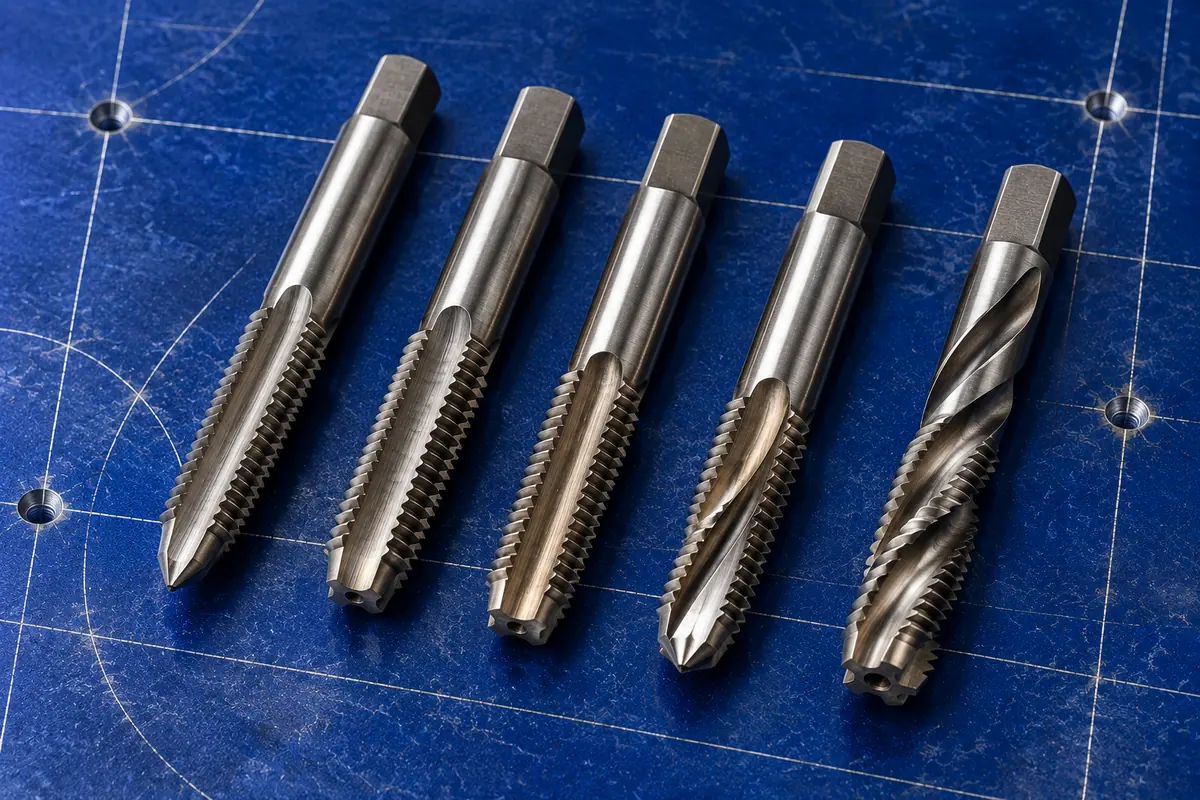
A tap set usually comes as three taps that look nearly the same. They differ in how many threads at the tip are ground away, and that one detail decides where each tap is useful. Flute shape matters just as much, because it decides where the chips go.
The chamfer is the difference
The first few threads of a tap are ground down into a taper called the chamfer. Those threads start small and grow to full size, so the cutting load is spread over several teeth instead of one. A long chamfer starts easily and cuts gently. A short chamfer reaches full thread sooner, which you need at the bottom of a blind hole, but each tooth works harder.
Taper taps
A taper tap has the longest chamfer, 7 to 10 threads according to F&L Technical Sales and Cutting Tool Supply.[1][2] Wikipedia's tap and die article gives 8 to 10.[3] Taper taps are used in through holes and in materials where a long guide helps,[1] and Wikipedia notes they are most often used when the material is hard to work, such as alloy steel.[3] The long lead also makes them the easiest to start straight by hand.
Plug taps
Plug taps have a 3 to 5 thread chamfer and are the most widely used type, for through holes and for blind holes with room at the bottom.[1][2] If a store sells one tap of a size, it is almost always a plug tap. It starts well enough by hand if the hole is chamfered and you keep it square.
Bottoming taps
A bottoming tap has only 1 to 2 threads of chamfer,[1][2] or 1 to 1-1/2 by Wikipedia's figure,[3] so it cuts full threads almost to its tip. That short lead cannot start a thread in a plain hole,[3] so it follows a plug or taper tap. Cutting Tool Supply warns that bottoming taps create the most tapping torque and should be used only when the threads must come close to the bottom of the hole.[2] A semi-bottoming chamfer of 2 to 2-1/2 threads sits in between and is offered for tough materials in blind holes.[1]
Metric chamfer letters
Metric taps made to DIN 2197 use letters instead of names. ISCAR's catalog lists them:[4]
| Form A | 6 to 8 threads, for short through holes |
|---|---|
| Form B | 3.5 to 5 threads, with spiral point, for through holes |
| Form C | 2 to 3 threads, for blind holes, and generally for aluminum, gray cast iron and brass |
| Form D | 3.5 to 5 threads |
| Form E | 1.5 to 2 threads, avoid if possible |
| Form F | 1 to 1.5 threads, avoid if possible |
BAER, a German tap supplier, gives form B as 3.5 to 5.5 threads, a small difference from ISCAR's figure.[5]
Straight, spiral point and spiral flute
Straight flute taps are the classic hand tap. The chips collect in the flutes, which works for short holes until the flutes fill; USCTI's rule of thumb is a maximum depth of 1-1/2 times the tap diameter with a four-flute hand tap.[6] Straight flutes suit short-chipping materials like cast iron and brass, which is also why ISCAR lists the short form C chamfer for those metals.[4]
Spiral point taps, also called gun taps, have an angled grind at the front that breaks the chip and throws it forward, ahead of the tap.[3] USCTI describes them as pushing chips ahead, which makes them the ideal choice for through holes; it advises running them at least one thread past the spiral-point section, and says they can run 30 to 40% faster than a hand tap.[6] Because chips go forward, BAER points out that a spiral point tap cannot be used in blind holes, and spiral point taps always have a form B chamfer.[5]
Spiral flute taps have helical flutes like a drill and pull chips up and out of the hole. USCTI calls them ideal for blind holes and recommends running them 25 to 30% slower than a hand tap.[6] For aluminum in blind holes, Cutting Tool Engineering recommends spiral flute taps and warns against spiral point taps.[7]
Forming taps
Thread-forming taps have no cutting edges at all. They push metal into shape instead of cutting it, so there are no chips, and they need a larger drilled hole. They only work in ductile materials; USCTI gives limits of under 30 HRC hardness,[6] and Wikipedia notes they can last 3 to 20 times longer than cutting taps.[3] McMaster-Carr adds that they make stronger threads but need an exact hole size.[8] The forming tap guide covers the drill sizes.
HSS, cobalt and carbide
Plain high-speed steel (HSS) is the all-round tap material for general work.[9] HSS-E, alloyed with cobalt, is harder and holds up better to heat, at the cost of a higher risk of breaking.[9] Powder-metal HSS adds wear and heat resistance on top of that.[9]
Carbide is for hard and abrasive materials. A GWS Tool Group guide published by USCTI puts HSS taps' practical limit at about 35 to 40 HRC and carbide's at about 65 HRC, and stresses that carbide needs a rigid setup and exact alignment; it is generally not a hand tapping tool.[10] Carbide is very hard and very brittle, and a hand wrench applies exactly the side load it handles worst.
How to tell them apart
Taps are not always marked with their type. Look at the tip:
- Count the tapered threads. Seven or more is a taper tap, three to five a plug, one or two a bottoming tap.[1]
- Look at the front of the flutes. A spiral point tap has an angled grind on the cutting face at the tip, so the flute looks twisted only at the very front.[3]
- Look along the body. Spiral flute taps have helical flutes the full length, like a drill.[6]
- No flutes at all, just a lobed, slightly polygonal thread with an oil groove, means a forming tap.
Common mistakes
- Starting with a bottoming tap. Its short lead cannot start a thread in a plain hole.[3]
- A spiral point tap in a blind hole. It drives chips to the bottom, where they jam the tap.[5]
- Carbide in a hand wrench. Carbide needs a rigid, aligned setup and is generally not a hand tapping tool.[10]
- A straight flute tap in a deep hole without clearing chips. Past about 1-1/2 diameters the flutes fill up.[6]
- Drilling the cutting-tap size for a forming tap. The forming tap will jam or break. It needs a larger hole.[8]
Choosing for a job
| Through hole, by hand | Plug tap, or taper tap to start in hard material |
|---|---|
| Through hole, machine | Spiral point tap |
| Blind hole, by hand | Plug tap, then bottoming tap if the thread must reach the bottom |
| Blind hole, machine | Spiral flute tap, or a forming tap in ductile metal |
| Cast iron, brass | Straight flute; short chips fall out easily |
| Aluminum, mild steel, production | Consider a forming tap |
| Hardened steel | Carbide, on a rigid machine |
Whichever tap you use, the drill size is the same for cutting taps of a given thread. Look it up on the tap drill size pages, and see the blind hole guide for how chamfer length changes the drilling depth.
Sources
- Thumbnail Guide to Understanding Chamfers for Thread Cutting Taps, F&L Technical Sales
- Tap Chamfers, Cutting Tool Supply
- Tap and die, Wikipedia
- Threading Catalog 2023, p. 380, ISCAR
- Spiral point taps: What is that?, BAER
- Tap Style Selections by Chip Management, USCTI
- Tips and Tricks for Threading Aluminum Parts, Cutting Tool Engineering
- Thread-Forming Taps, McMaster-Carr
- HSS, Co.: basic materials for taps, BAER
- Carbide Taps: A Practical User's Guide (GWS Tool Group), USCTI
Found an error? Email [email protected]. Our editorial policy explains how guides are researched and corrected.
 Taper, plug and bottoming tap set