
How to calculate tap drill size
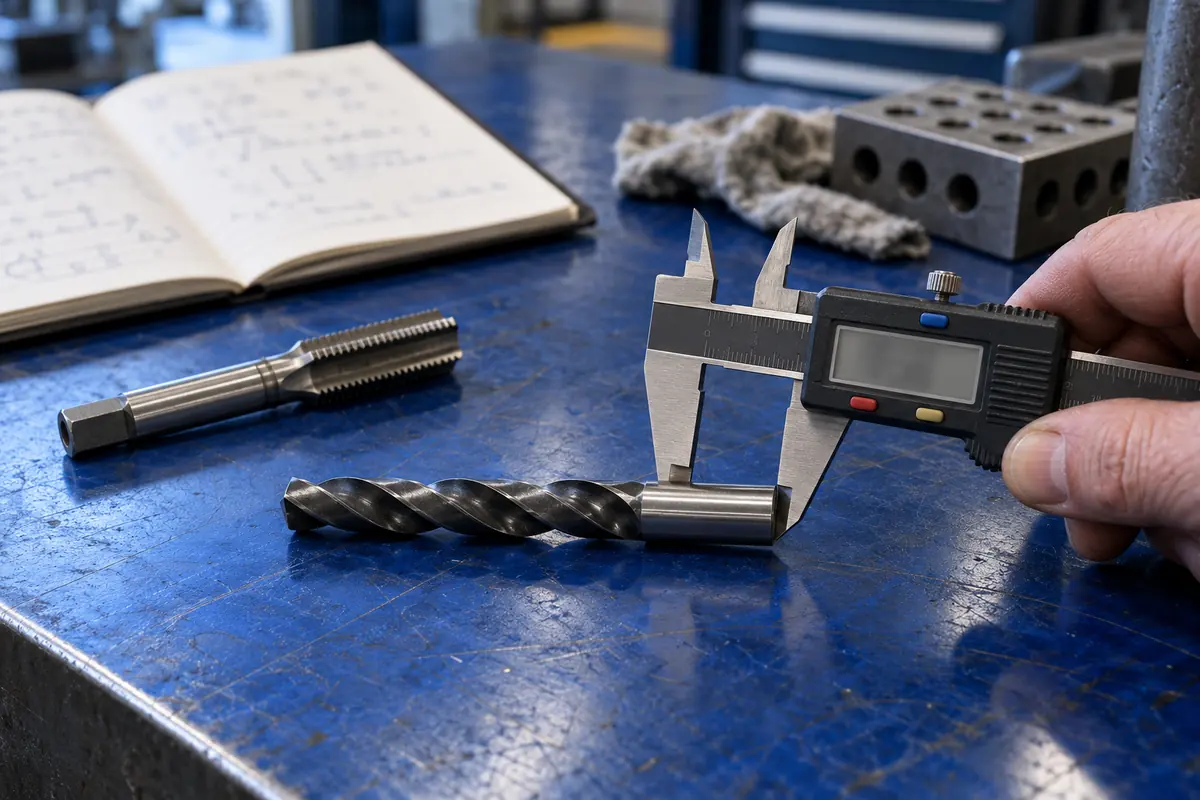
Every tap drill chart is built from one short formula. Once you know it, you can check a chart, work out a drill for a thread no chart lists, and understand why two charts sometimes disagree by a drill size.
The inch formula
OSG, one of the largest tap makers, prints the formula this way:[1]
Drill size = Tap major diameter − (0.01299 × % of full thread) ÷ threads per inch
The percentage goes in as a whole number, so 75% is entered as 75.[2] Turned around, the same formula tells you what a given drill will leave:[1]
% of full thread = threads per inch × (major diameter − drill diameter) ÷ 0.01299
Tapmatic publishes the identical inch formula,[3] and North American Tool rounds the constant to .013.[2] The rounding changes the answer by less than a ten-thousandth for common sizes.
Where 0.01299 comes from
The constant is a thread depth in disguise. The old American National standard defined the basic thread depth as 0.6495 times the pitch. The University of Wisconsin engineering knowledge base gives it as 0.6495 divided by threads per inch,[4] and the U.S. Bureau of Standards' 1929 tables list tap drills by percent of that depth.[5]
A tapped hole loses that depth on both sides, so a full-depth hole is 2 × 0.6495 = 1.299 pitches smaller than the major diameter. Divide by 100 to work in percent and you get 0.01299. North American Tool's sheet shows the same thing in numbers: the double thread depth for 20 threads per inch is 0.06495 in.[2]
This has one surprising effect. The modern Unified and ISO thread profile is shallower than that old basic depth: its working depth is 5/8 of the sharp-V height, about 0.541 times the pitch.[6] So "100% thread" in tap-drill arithmetic is a deeper thread than the standard profile actually needs, and drilling exactly to the basic minor diameter works out to roughly 83% on this scale. It is part of the reason 75% holes hold so well.
Metric: diameter minus pitch
For metric threads the shop rule is simpler: subtract the pitch from the diameter. The University of Wisconsin physics instrument shop gives the example of M5 x 0.8 taking a 4.2 mm drill,[7] and BAER, a German tool supplier, states the same rule for metric taps.[8]
The full metric formula from Tapmatic is:[3]
Drill (mm) = major diameter − (% of thread × pitch ÷ 76.98)
% of thread = 76.98 ÷ pitch × (major diameter − drilled hole)
Put a drill of exactly diameter minus pitch into the second formula and the pitch cancels: the answer is 76.98% for every size. So the metric rule of thumb is really a 77% rule, very close to the 75% inch convention. The constant 76.98 is just 100 divided by 1.299.
Picking a stock drill
The formula gives an exact hole. The next step, as North American Tool's sheet says, is to select the nearest commercial stock drill.[2] For inch threads that may be a number, letter or fractional drill, which is why so many tap drills are number sizes. The drill bit size chart lists them all.
When the exact hole falls between two drills, OSG's principle is to use the largest drill that still gives adequate strength, because a lower percentage is easier to tap.[1] Bob Warfield makes the related point in Cutting Tool Engineering: there is no single drill size for a tap, and the size on the packet is almost always for 75% thread.[9]
Class limits on the hole
For threads that must meet a class, the drilled hole also has to land inside the minor-diameter limits. OSG notes that sometimes a higher percentage is needed for this reason.[1] For a 1/4-20 class 2B thread, OSG's table gives a minor diameter between 0.1960 and 0.2070 in.[1] David Miskinis of Greenfield Industries, writing in Cutting Tool Engineering, puts it the useful way round: any drill that produces a hole in that window can be used.[10]
Metric threads have the same kind of window. For ISO tolerance class 6H, Brighton-Best's table gives an M6 x 1 minor diameter of 4.917 to 5.153 mm and M8 x 1.25 of 6.647 to 6.912 mm.[11] By the metric formula, the M6 window runs from about 65% to 83% thread, so a "50% thread" hole is not possible in 6H.
Holes come out oversize
A drill rarely cuts its own size. Miskinis measured #7 jobber drills cutting holes that averaged 0.0038 in larger than the drill, which turned a nominal 75% hole into about 70%.[10] His conclusion is the most useful sentence in tapping: the size of the hole matters far more than the diameter of the drill that made it.[10] If a thread must be exact, measure the hole.
Worked examples
1/4-20 UNC at 75%
0.250 − (0.01299 × 75 ÷ 20) = 0.250 − 0.0487 = 0.2013 in
Nearest stock drill: #7 at 0.2010 in
Check: 20 × (0.250 − 0.201) ÷ 0.01299 = 75.4%
With Miskinis's 0.0038 in oversize: hole 0.2048 in, about 70%, still inside 2B (0.1960 to 0.2070)
M8 x 1.25 at 77%
8 − 1.25 = 6.75 mm
Check: 76.98 × (8 − 6.75) ÷ 1.25 = 77.0%
A 6.8 mm drill, the common stock size: 76.98 × 1.2 ÷ 1.25 = 73.9%
Both are inside the 6H minor diameter of 6.647 to 6.912 mm
OSG's own example: 2-12 at 70%
0.01299 × 70 = 0.9093; ÷ 12 = 0.0758
2.0000 − 0.0758 = 1.9242 in
These match OSG's published working.[1] For any other thread, the tap drill calculator does the same arithmetic and lists the stock drills either side.
Crossing inch and metric
The formulas do not care what units the drill was made in, as long as you convert before you calculate. That makes it easy to check a substitute.
Inch thread, metric drill: 1/4-20 with a 5.1 mm drill. 5.1 ÷ 25.4 = 0.2008 in. 20 × (0.250 − 0.2008) ÷ 0.01299 = 75.8%
Metric thread, inch drill: M8 x 1.25 with a letter H drill (0.266 in). 0.266 × 25.4 = 6.756 mm. 76.98 × (8 − 6.756) ÷ 1.25 = 76.6%
Both are as good as the "correct" drill. Every size page on this site lists the closest drill from the other system and the thread it leaves.
Common mistakes
- Entering the percentage as a decimal. The formula wants 75, not 0.75. North American Tool's sheet spells this out.[2] Put in 0.75 and the answer is a hole barely smaller than the screw.
- Using the wrong threads per inch. A 1/4 in screw comes as 20, 28 or 32 threads per inch. The fine thread needs a noticeably larger drill, so confirm the pitch before you calculate.
- Trusting the drill instead of the hole. If the thread is critical, measure what you drilled. The hole is what the tap sees.[10]
- Ignoring class limits. A drill that gives a sensible percentage can still fall outside the minor-diameter window for class 2B or 6H.[1]
- Using this formula for forming taps. Thread-forming taps need a much larger hole and a different constant; see the forming tap guide.
Rules of thumb, and their limits
Wikipedia's tap drill list gives a quick check: a good tap drill is about 85% of the major diameter for coarse threads and about 90% for fine threads, and it says this works best from 1/4 to 1 in.[12] For 1/4-20, 85% of 0.250 is 0.2125 in, which is close to a #3 drill and noticeably larger than the #7 the formula gives, so treat the shortcut as a sanity check, not an answer.
Old charts are not gospel either. A paper in the Transactions of the ASME on how tap drill sizes were developed noted that charts were generally made up from the opinions of operators.[13] That history explains most of the one-size disagreements you will see between published charts, and why this site shows both values when they differ.
Sources
- Tapping Guide Vol. 3: Tap Drill Sizes and Pitch Diameter Limits, OSG
- Formula for Tap/Drill Sizes (Inch), North American Tool
- Tapping Formulas, Tapmatic
- Thread depth, University of Wisconsin-Madison Engineering knowledge base
- American National Screw Thread Tables for Shop Use, Misc. Pub. 98, U.S. Bureau of Standards (1929)
- ISO metric screw thread, Wikipedia Background on the basic profile.
- Metric tap drill chart, UW-Madison Physics instrument shop
- Core hole dimensions for screw taps, BAER
- Seven Ways to Avoid Breaking Taps, Bob Warfield, Cutting Tool Engineering (2022)
- Know What You're Tapping, David Miskinis, Cutting Tool Engineering (1997)
- Thread Details, Metric Series, Brighton-Best International
- List of drill and tap sizes, Wikipedia
- The Development of Tap-Drill Sizes, A. C. Danekind, Transactions of the ASME Abstract.
Found an error? Email [email protected]. Our editorial policy explains how guides are researched and corrected.
 Digital caliper
 Number drill set
 Thread plug gauge