
Number, letter, fractional and metric drill sizes explained
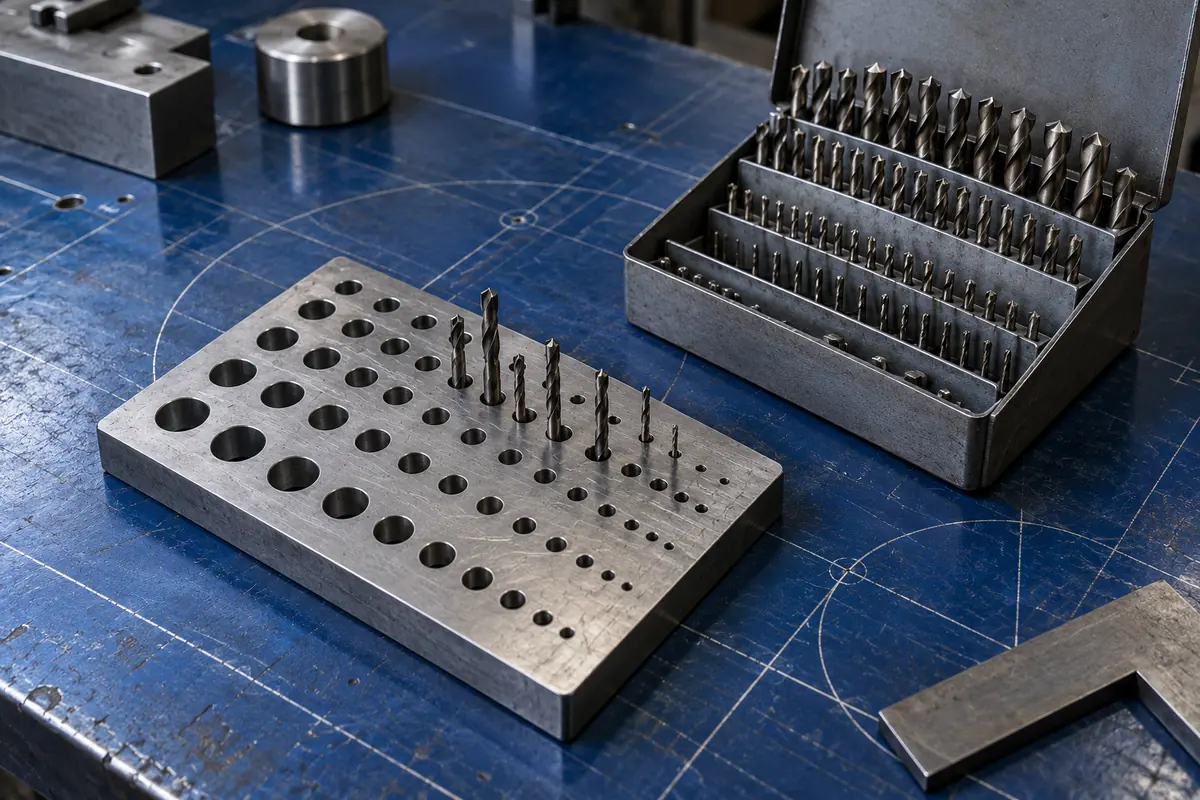
American shops use four drill size systems at once. Number drills run backwards, letter drills pick up where they stop, fractional drills step in 64ths, and metric drills are named in millimetres. It looks like a mess, but each system fills gaps the others leave, and knowing how they fit together saves a lot of squinting at drill indexes.
Number drills
Number drills run from #80, the smallest, to #1, the largest.[1] The standard goes as far as #97, but sizes smaller than #80 are rarely used.[1] A few anchor sizes, as listed by Wikipedia and by Engineers Edge citing the ASME B94.11M standard:[1][2]
| #80 | 0.0135 in (0.343 mm) |
|---|---|
| #60 | 0.0400 in |
| #1 | 0.2280 in (5.791 mm) |
The steps between them are irregular. The numbers do not come from a formula.
Where the numbers came from
The gauge-to-diameter relationship is not defined by a formula; it is based on, but not identical to, the Stubs Steel Wire Gauge, which originated in Britain in the 19th century.[1] On wire gauges a higher number means wire drawn finer, which is why number drills shrink as the number grows. Engineering ToolBox's gauge tables show Stubs' steel wire gauge 1 at 0.227 in,[3] a thousandth under the #1 drill's 0.228 in. The name comes from Peter Stubs, a Warrington file maker who was in business by 1777.[4]
In the United States, twist drill sizes and tolerances are now set by ASME B94.11M, which covers nomenclature, definitions, sizes and tolerances for high-speed steel straight and taper shank drills.[5] It replaced the older ANSI B94.11M editions.[6]
Letter drills
Letter drills continue above #1, from A (the smallest) to Z (the largest).[1] A is 0.234 in and Z is 0.413 in.[1][2] So the sequence runs #80 up to #1 at 0.228 in, then A at 0.234 in, and on to Z.
Fractional drills
Fractional jobber drills are standardized from 1/64 to 1 in, in 1/64 in steps,[1] and their sizes are written as fractions in lowest terms, so 32/64 is written 1/2.[1] A 64th is 0.0156 in, which is coarse compared with the gaps between number drills: between 3/16 (0.1875) and 13/64 (0.2031) there are six number sizes.
Metric drills
Metric drills are simply named by diameter in millimetres. British Standard BS 328, for example, defines 230 sizes from 0.2 to 25.0 mm.[1] Tap drill sizes that fall between the half-millimetre steps of common sets, such as 3.3, 4.2 and 6.8 mm, are sold individually.
Where the systems overlap
Because the systems interleave, most number and letter drills have a fractional or metric drill within a few thousandths. These are worked from the chart values, and they are the substitutions people make most:
| Drill | Decimal | Nearest fraction | In mm |
|---|---|---|---|
| #43 | 0.0890 in | 3/32 (0.0938) | 2.26 |
| #36 | 0.1065 in | 7/64 (0.1094) | 2.71 |
| #29 | 0.1360 in | 9/64 (0.1406) | 3.45 |
| #7 | 0.2010 in | 13/64 (0.2031) | 5.11 |
| Letter F | 0.2570 in | 1/4 (0.2500) | 6.53 |
| Letter Q | 0.3320 in | 21/64 (0.3281) | 8.43 |
Close is not always close enough. A 9/64 in drill is 0.0046 in larger than a #29, which drops an 8-32 thread from about 69% to about 58%. Each tap drill page on this site gives the substitute's thread percentage so you can judge it.
Worked example: is the fraction close enough?
Three common threads, each with its number drill and the nearest fraction, worked with the tap drill formula (% = threads per inch × (major − drill) ÷ 0.01299):
1/4-20: #7 gives 75.4%; 13/64 gives 72.2%. The fraction is a hair larger and perfectly usable.
10-32: #21 gives 76.4%; 5/32 gives 83.1%. The fraction is smaller, so the thread is deeper and the tap works harder. Fine in aluminum, risky in stainless.
8-32: #29 gives 69.0%; 9/64 gives 57.6%. The fraction is larger and the thread gets light. Acceptable for light loads; for anything that matters, buy the #29.
The pattern holds generally: a fractional substitute within about 0.002 in of the number drill is usually fine, and beyond that it is worth checking the percentage. The calculator lists the nearest drills in every system with the thread each leaves.
Why tap drills are odd sizes
A tap drill has to land near a specific diameter for each thread, and the fractional series is too coarse to hit those targets. Number and letter drills fill the gaps. A Little Machine Shop tap chart shows how often that happens: 4-40 takes a #43, 8-32 a #29, 10-24 a #25, and 5/16-18 a letter F.[7] Wikipedia describes the number and letter series as covering the sizes for which twist drills are most often used.[1]
The drill bit size chart lists every number, letter and fractional size side by side, and the fraction to decimal chart gives the nearest number or letter drill for each 64th.
Drill lengths
The same diameter comes in several lengths:
- Jobber length is the most common drill.[1] Its flutes are generally 9 to 14 times the drill diameter.[8]
- Screw machine or stub drills are the shortest. Short flutes make them stiffer and more accurate, but they can only drill as deep as the flutes.[8]
- Taper length drills have longer flutes than jobbers and drill deeper holes.[8][9]
- Aircraft length, or extended-reach, drills come in fixed lengths such as 6, 8, 12 or 18 in.[1]
For tapping, a stub drill is worth having in the common tap drill sizes: it walks less, so the hole starts where you punched it.
Which sets to buy
McMaster-Carr's jobber sets show the standard configurations: a 29-piece fractional set from 1/16 to 1/2 in by 64ths, a 26-piece letter set, a 60-piece number set (#1 to #60), an 80-piece number set, and a 115-piece set that combines fractional, number and letter drills.[10] A combination drill index of 115 pieces breaks down as 29 fractional, 60 number and 26 letter drills.[11] Metric sets commonly run 1.0 to 13.0 mm in 0.5 mm steps, 25 pieces.[10]
If you tap inch threads, the 115-piece set covers the tap drill for every thread from #1-64 up to 1/2-13; only #0-80, at 3/64 in, falls outside it. If you mostly tap metric, a 0.5 mm-step set plus individual 2.5, 3.3, 4.2, 6.8 and 8.5 mm drills covers the common coarse threads.
Common mistakes
- Mixing up drill numbers and screw numbers. A #8 drill is 0.199 in. A #8 screw is 0.164 in. They have nothing to do with each other.
- Reading the number series the wrong way. Bigger number, smaller drill, until you reach the letters, where bigger letter means bigger drill.[1]
- Treating letter F as a quarter inch. It is 0.257 in, 0.007 in larger, which matters for a tap drill.
- Measuring across the flutes. The fluted part has clearance ground into it. Measure the shank, or use a gauge plate.
Identifying an unmarked drill
Drill markings wear off the shank. A drill gauge plate solves it: Starrett's No. 186 has 60 holes, #1 to #60, each marked with its number and decimal size.[12] Slide the drill into the smallest hole it fits. A caliper on the shank works too; measure the shank, not the fluted part, and compare with the chart.
Sources
- Drill bit sizes, Wikipedia
- Inch and Metric Drill Bit Size Chart, Engineers Edge Cites ASME B94.11M-1993.
- Standard Gauges, Engineering ToolBox
- Peter Stubs, Grace's Guide to British Industrial History
- ASME B94.11M-1993: Twist Drills, ANSI Webstore
- USAS B94.11M / ANSI B94.11M, University of Illinois standards listing
- Tap & Clearance Drill Sizes, LittleMachineShop.com (UCSB copy)
- Twist Drill Length, Regal Cutting Tools
- Taper Shank Twist Drills, AmesWeb
- Jobbers' Drill Bit Sets, McMaster-Carr
- Huot 3-in-1 Combination Drill Case, Penn Tool Co.
- 186 Drill and Steel Wire Gage, L.S. Starrett
Found an error? Email [email protected]. Our editorial policy explains how guides are researched and corrected.
 115-piece drill index
 Drill gauge