
Pilot holes for wood screws: how to size them
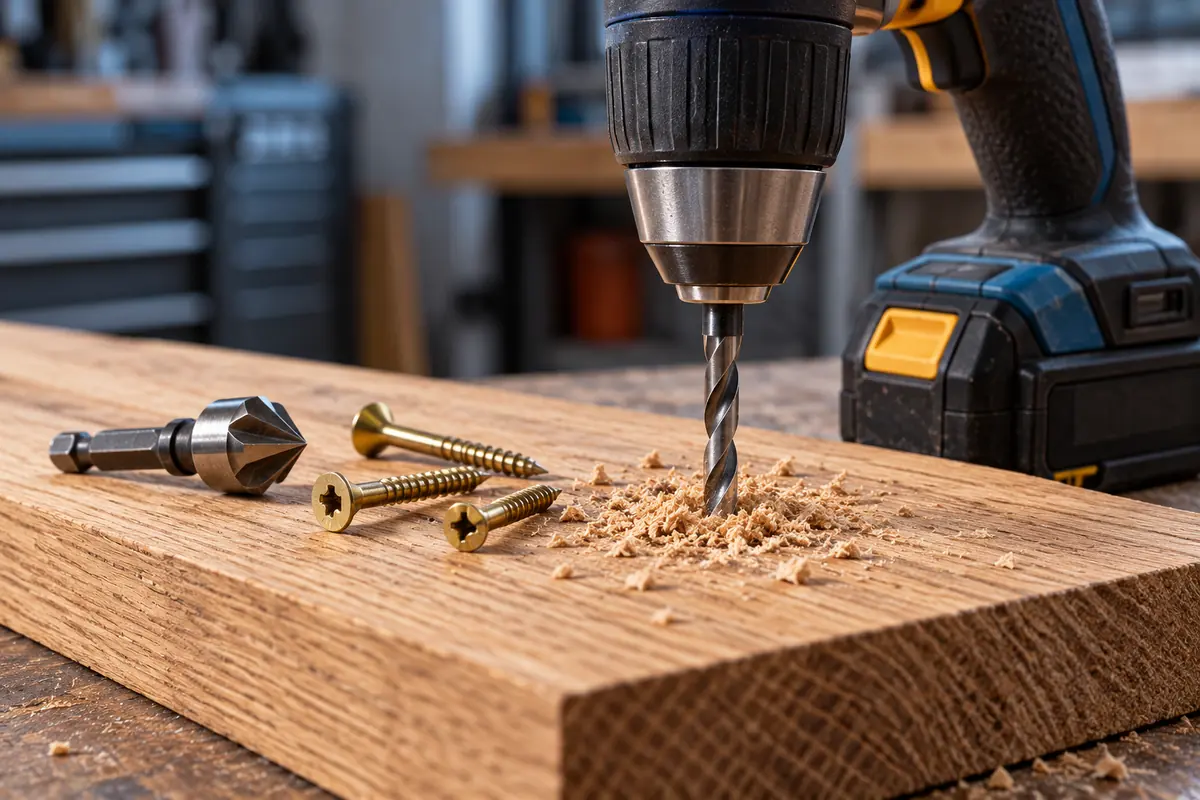
A wood screw holds by cutting a thread into the wood around a pilot hole. Make the hole too small and the screw splits the board or snaps; too big and it strips. The sizes on a chart are rounded rules of thumb, and they make more sense once you know what they are rounded from.
Screw gauges and diameters
Wood screws are sized by gauge number, and the diameter follows a simple rule: 0.060 in plus 0.013 in per gauge number. Amarillo College's machining notes give the rule for numbered screws,[1] and it matches published wood screw tables. Bolt Depot lists #6 at 0.138 in, #8 at 0.164 in and #10 at 0.190 in,[2] and the USDA Wood Handbook's table of shank diameters runs from #4 at 0.112 in to #24 at 0.372 in.[3]
#8: 0.060 + 0.013 × 8 = 0.164 in. #10: 0.060 + 0.013 × 10 = 0.190 in.
Size the pilot to the root
The threads of a screw stand out from a solid core called the root. The pilot hole should be close to the root diameter, so the threads cut into solid wood and the core slides through the hole without wedging it apart.
The Wood Handbook says the root diameter of most screws averages about two-thirds of the shank diameter.[3] Its screw-holding formulas assume lead holes of about 70% of the root diameter in softwoods and about 90% in hardwoods.[3] For a #8 screw that works out to a root of about 0.109 in, a softwood pilot of about 0.077 in and a hardwood pilot of about 0.098 in.
The National Design Specification for wood construction sets a slightly larger figure. As summarized by Simpson Strong-Tie's engineers, for wood with a specific gravity under 0.6 the part of the lead hole receiving the threads should be about 7/8 of the root diameter.[4] The two references were written for different purposes, the Handbook to describe tested holding strength and the NDS to set design rules, and both land in the same range.
Hardwood vs softwood
Dense wood resists the screw more, so it gets a hole closer to the root diameter. Softwood can take a smaller hole because its fibers compress. Chart columns follow that pattern. Engineering ToolBox's chart, which it describes as approximate, gives a #8 screw a 7/64 in pilot in hardwood and 5/64 in in softwood.[5]
Which column is your wood? Oak, maple, hickory and ash are hardwoods for this purpose. Pine, spruce, fir and cedar are softwoods. When in doubt, drill a test hole in scrap: if the screw is hard to turn or the wood bulges, go up a size.
The shank clearance hole
When a screw joins two boards, the top board needs a different hole. Popular Woodworking's Steve Shanesy explains it: a clearance hole lets the screw pass through without its threads biting, and without one, the screw cannot draw the first piece tight against the second.[6] If the threads grip both boards, they hold them apart.
The Wood Handbook says the part of the hole receiving the shank should be the same diameter as the shank or slightly smaller.[3] In practice that is a drill about the size of the screw's outside diameter: Engineering ToolBox lists 11/64 in for a #8.[5]
How deep to drill the pilot
The pilot only has to reach as far as the screw's threads will go. Drill it to about the length of the screw that will sit in the lower board, measured from the joint line, and no deeper than the screw: a pilot that runs past the tip leaves the last threads in an open hole. For MDF, Wengert's advice is the opposite small detail: drill a little deeper than the screw, because the material compresses poorly and needs somewhere for the tip to go.[7]
A depth stop collar on the bit, or a flag of tape, keeps repeated holes the same. Combination countersink bits set the depth with a collar on the bit itself.
Countersinks and counterbores
A flat-head screw needs a countersink so the head sits flush with or below the surface.[6] Combination countersink bits drill the pilot, the shank hole and the countersink in one pass, and their sizes are given as taper-point sizes, which run a little larger than straight-bit pilots because the bit is tapered.
To hide a screw under a wood plug, counterbore instead. This Old House's advice is a counterbore slightly larger than the screw head and slightly smaller than the plug's widest end, glued in with the grain lined up.[8]
Worked example: #8 screw joining 3/4 in oak to a pine frame
Screw diameter: 0.060 + 0.013 × 8 = 0.164 in
Oak top board, clearance hole the size of the shank: 11/64 in (0.172 in)
Pine frame, threaded part: Handbook guide 70% × (2/3 × 0.164) = 0.077 in, so 5/64 in (0.078 in)
Countersink the oak for a flat head
The #8 wood screw page gives the chart sizes for the threaded part in both woods.
Edges and end grain
Most splitting starts near the end of a board. The Wood Handbook sets minimum spacing for laterally loaded screw joints: an end distance of at least the side member's thickness and an edge distance of at least half of it.[3] Screws in end grain also hold less: the Handbook says withdrawal from end grain is erratic and averages about 75% of side-grain values when splitting is avoided.[3]
Lubricant helps. The Handbook recommends soap or a similar lubricant on the screw to make insertion easier.[3] And it is firm on technique: screws should always be turned in, never started or driven with a hammer, because that tears the wood fibers and damages the threads.[3]
MDF and particleboard
MDF has no grain to hold threads the way solid wood does, and it splits along its faces. The European Panel Federation's guidance calls for a pilot of 85 to 95% of the screw's core diameter, with face screws at least 12 mm from the edge and 25 mm from corners, and edge screws at least 70 mm from corners.[9] Gene Wengert, writing for Woodworking Network, recommends 85 to 90% of the root diameter, drilled a little deeper than the screw, for edges and faces alike.[7] Both are much closer to the root than for solid softwood.
Screws that need no pilot
Modern structural and deck screws are designed with drilling points and thread forms that let them drive without a pilot. Simpson Strong-Tie says it does not typically recommend or require predrilling for its screws.[4] GRK says its RSS structural screws drive into most woods without pre-drilling,[10] and SPAX says its multi-material deck screws can be driven without pilot holes, while noting that pilots are generally recommended for deck boards with other screws because they relieve the stress that splits wood.[11] Follow the screw maker's instructions for those products; the charts here are for conventional wood screws.
Common mistakes
- Sizing the pilot to the outside of the threads. That is a clearance hole; the screw will strip.
- No clearance hole in the top board. The joint will not pull tight.[6]
- Using the softwood size in oak. Small screws snap; larger ones split the board.
- Screwing near the end of a board. Keep at least the board's thickness from the end.[3]
- Hammering a screw to start it. It damages both the wood and the thread.[3]
Sources
- Thread calculations, Amarillo College Machining
- Wood Screw Diameters, Bolt Depot
- Wood Handbook (FPL-GTR-282, 2021), Chapter 8: Fastenings, USDA Forest Products Laboratory
- Common Technical Engineering Inquiries, Part III: Fasteners, Simpson Strong-Tie Summarizes NDS lead-hole provisions.
- US Wood Screws: Pilot Holes, Engineering ToolBox Sizes described as approximate.
- Pilot Holes, Clearance Holes and Countersinks, Popular Woodworking
- Why can't I screw into MDF?, Woodworking Network
- How to Hide Screwheads, This Old House
- Screwing MDF, European Panel Federation (mdf-info.eu)
- RSS Rugged Structural Screw, GRK Fasteners
- SPAX Deck Screws and the Pilot Hole Question, SPAX
Found an error? Email [email protected]. Our editorial policy explains how guides are researched and corrected.
 Countersink pilot bit set
 Wood screw assortment