
Lag screw pilot holes: the two-hole method
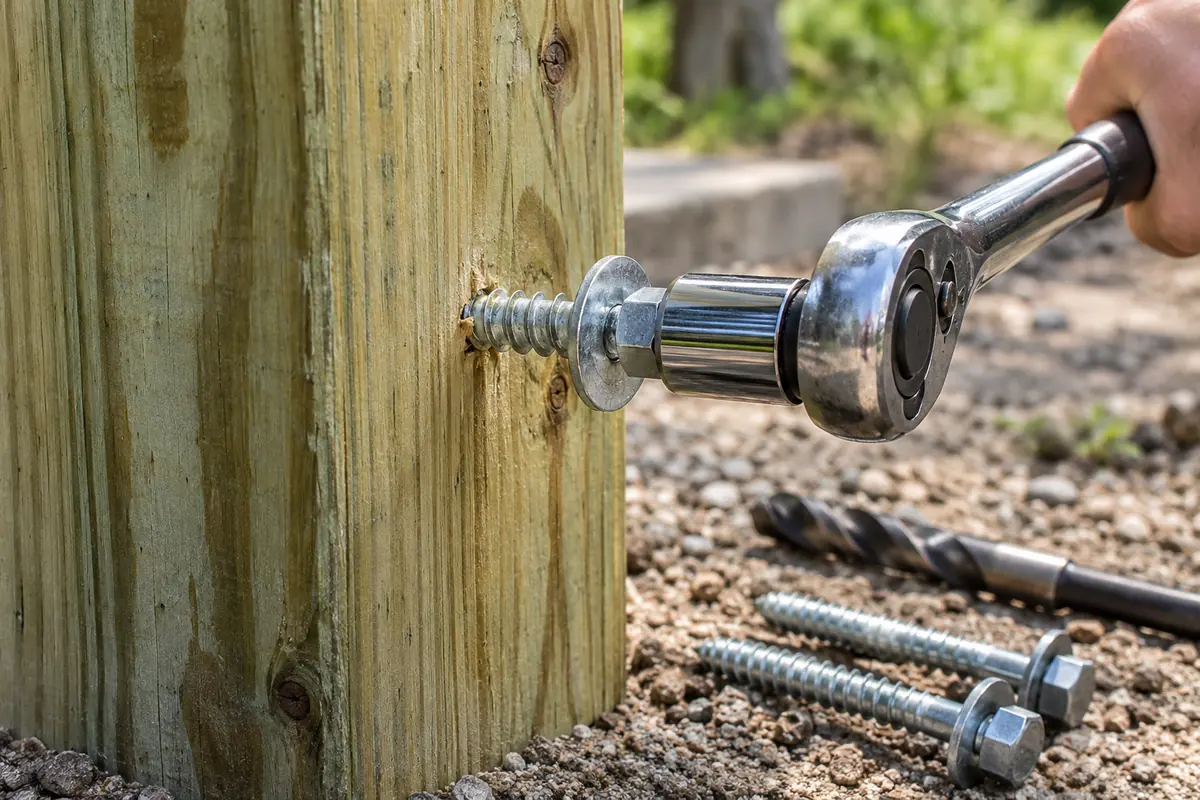
Published lag screw charts disagree, sometimes by two drill sizes for the same screw. The reason is that the right pilot depends on the wood's density, and charts pick different woods to assume. The USDA Wood Handbook gives the rule they are all approximating, and once you have it you can size a lag pilot for any wood.
Two holes, not one
A lag screw has a smooth shank under the head and a coarse thread below it. The Wood Handbook says lag screws, like wood screws, need prebored holes of the proper size, and that the lead hole for the shank should be the same diameter as the shank.[1] So a lag joint has two holes: a full-size hole as deep as the smooth shank, and a smaller lead hole for the threaded part.
Skip the shank hole and the shank wedges into wood that has only been drilled for the threads, which can split a post or twist the screw off.
The Wood Handbook rule
For the threaded part, the Handbook sizes the lead hole as a percentage of the shank diameter, by wood density:[1]
| Low-density softwoods (cedars, white pines) | 40 to 70% of the shank diameter |
|---|---|
| Douglas-fir and Southern Pine | 60 to 75% |
| Dense hardwoods such as oaks | 65 to 85% |
The Handbook adds that the smaller percentages go with the smaller screws.[1] The 2021 edition gives the same figures as the 1999 edition, so this guidance has been stable for decades.[1][2]
The Handbook also shows what happens with an oversized lead hole: a rough, shallow thread in the wood, because the screw has too little material to bite.[1]
Wood density, in numbers
The groups above are density classes. Engineers Edge's table of oven-dry specific gravity, from American Forest and Paper Association data, puts numbers on common species groups:[3]
| Eastern white pine, western cedars | 0.36 |
|---|---|
| Spruce-pine-fir (SPF) | 0.42 |
| Hem-fir | 0.43 |
| Douglas fir-larch | 0.50 |
| Southern pine, mixed maple | 0.55 |
| Red oak | 0.67 |
| White oak | 0.73 |
So SPF studs fall near the low-density group, construction-grade Douglas fir and Southern pine sit in the middle group, and oak is in the dense group. Withdrawal strength rises steeply with density: the Handbook's withdrawal formula uses specific gravity to the power 1.5.[1]
Worked out by size
Here are the Handbook percentages worked out for common lag diameters, with the nearest fractional drills. Since smaller screws take the lower end of each range, start low for 1/4 and 5/16 in lags and higher for 1/2 in and up.
| Lag | Cedar, white pine (40 to 70%) | Douglas fir, Southern pine (60 to 75%) | Oak (65 to 85%) |
|---|---|---|---|
| 1/4 in | 0.100 to 0.175 in (3/32 to 11/64) | 0.150 to 0.188 in (5/32 to 3/16) | 0.163 to 0.213 in (5/32 to 7/32) |
| 5/16 in | 0.125 to 0.219 in (1/8 to 7/32) | 0.188 to 0.234 in (3/16 to 15/64) | 0.203 to 0.266 in (13/64 to 17/64) |
| 3/8 in | 0.150 to 0.263 in (5/32 to 17/64) | 0.225 to 0.281 in (7/32 to 9/32) | 0.244 to 0.319 in (1/4 to 5/16) |
| 1/2 in | 0.200 to 0.350 in (13/64 to 11/32) | 0.300 to 0.375 in (19/64 to 3/8) | 0.325 to 0.425 in (21/64 to 27/64) |
For reference, the thread root diameters from the ASME B18.2.1 lag screw table, as published by Engineers Edge, are 0.173 in for 1/4 in, 0.227 in for 5/16, 0.265 in for 3/8 and 0.371 in for 1/2.[4] The Handbook's upper percentages approach these root diameters in dense wood.
Thread length and the shank hole depth
The depth of each hole depends on how much of the screw is threaded. The ASME B18.2.1 lag screw table, as published by Engineers Edge, sets the minimum thread length at half the screw length plus 0.50 in, or 6.00 in, whichever is shorter.[4] The rest is smooth shank. The same table gives threads per inch for each size: 10 for 1/4 in, 9 for 5/16 in, 7 for 3/8 in and 6 for 1/2 in.[4]
4 in lag: minimum thread 4 ÷ 2 + 0.50 = 2.50 in, so at most 1.50 in of smooth shank
Drill the shank hole about 1.5 in deep at full diameter, then the lead hole for the remaining 2.5 in
Thread lengths vary by maker, so check the actual screw before drilling. The Handbook notes that commonly available lag screws run from about 0.2 to 1 in in diameter and 1 to 16 in long.[1] When the lag passes through a board into a post, the shank hole goes through the board and the lead hole goes into the post, which is why the two-hole method usually happens on its own.
Worked example: a 1/2 in lag into a Douglas fir post
Threaded part: 60 to 75% of 0.500 in = 0.300 to 0.375 in. A 5/16 in drill (0.3125 in) sits at 62.5%, at the low end, which suits a long screw in dense framing
Shank part: 1/2 in drill, to the depth of the smooth shank
That 5/16 in pilot matches what deck builders use. Mike Guertin, writing in the Journal of Light Construction about deck ledgers, gives a pilot of about 5/16 in for 1/2 in lags into the rim joist and a 17/32 to 9/16 in clearance hole through the ledger.[5] Fine Homebuilding covers the same practice.[6]
Driving the screw
The Handbook says lag screws should always be inserted by turning with a wrench, not by driving with a hammer.[1] Soap, beeswax or another lubricant on the threads makes insertion easier, especially in dense wood, and does not reduce performance.[1] The City of Phoenix's structural requirements say the same about turning the threaded part into its lead hole with a wrench, and require pilot holes for all lag screws except those 3/8 in or smaller loaded mainly in withdrawal.[7]
Use a washer under the head. For 1/2 in ledger lags, Guertin calls for washers 1-3/8 in across with a 9/16 in hole, tightened to draw the pieces together but not so tight that the washers crush the wood.[5]
End grain and spacing
The Handbook says lag screws should not be used in end grain, because the wood may split under side load, and that withdrawal from end grain is only about three-fourths of side-grain resistance.[1] Spacing, edge distance and end distance follow the rules for bolts of the same diameter as the lag's shank.[1]
Structural screws as an alternative
For many jobs once done with lags, especially deck ledgers, fastener makers now sell code-evaluated structural screws that install without a pilot. FastenMaster says no pre-drilling is required with its LedgerLOK screw,[8] and GRK lists an evaluation report for structural uses of its RSS screw.[9] Guertin's advice is to follow the maker's instructions and code evaluation report rather than the lag screw tables when using these.[5]
Common mistakes
- One hole for the whole screw. The shank needs its own full-size hole.[1]
- An oversized lead hole. The thread barely engages and the screw pulls out.[1]
- Using the oak size in cedar, or the cedar size in oak. Match the percentage to the wood.
- Lagging into end grain. It holds poorly and invites splitting.[1]
- No lubricant in dense wood. A bar of soap is the cheapest insurance against a twisted-off head.[1]
Sources
- Wood Handbook (FPL-GTR-282, 2021), Chapter 8: Fastenings, USDA Forest Products Laboratory
- Wood Handbook (FPL-GTR-113, 1999), Chapter 7: Fastenings Earlier edition, same figures.
- Specific Gravity and Weight of Wood, Engineers Edge AF&PA data.
- Standard Hex Lag Screws per ASME B18.2.1, Engineers Edge
- Installing a Deck Ledger, Mike Guertin, JLC
- Pilot Holes in a Deck Ledger, Fine Homebuilding
- TRT/DOC/00251 Lag Screws, City of Phoenix Planning & Development
- FastenMaster LedgerLOK vs 1/2 in Lag Screws, FastenMaster
- RSS Rugged Structural Screw, GRK Fasteners
Found an error? Email [email protected]. Our editorial policy explains how guides are researched and corrected.
 Lag screw assortment
 Drill bit set
 Socket and ratchet